Choosing the right Zoho CRM plan is about more than comparing Zoho CRM pricing and monthly subscription costs. The edition you choose affects automation, reporting, scalability, and long-term ROI.
Many businesses evaluating Zoho CRM pricing plans either outgrow their plan too quickly or pay for features they don't need. At CRMOZ, one of the most common questions we hear is: "Which Zoho CRM plan is right for us?"
In this guide, we'll compare Zoho CRM pricing, explain the differences between Zoho CRM plans, review the real Zoho CRM cost for different team sizes, and help you choose the best option based on your business needs and growth goals.
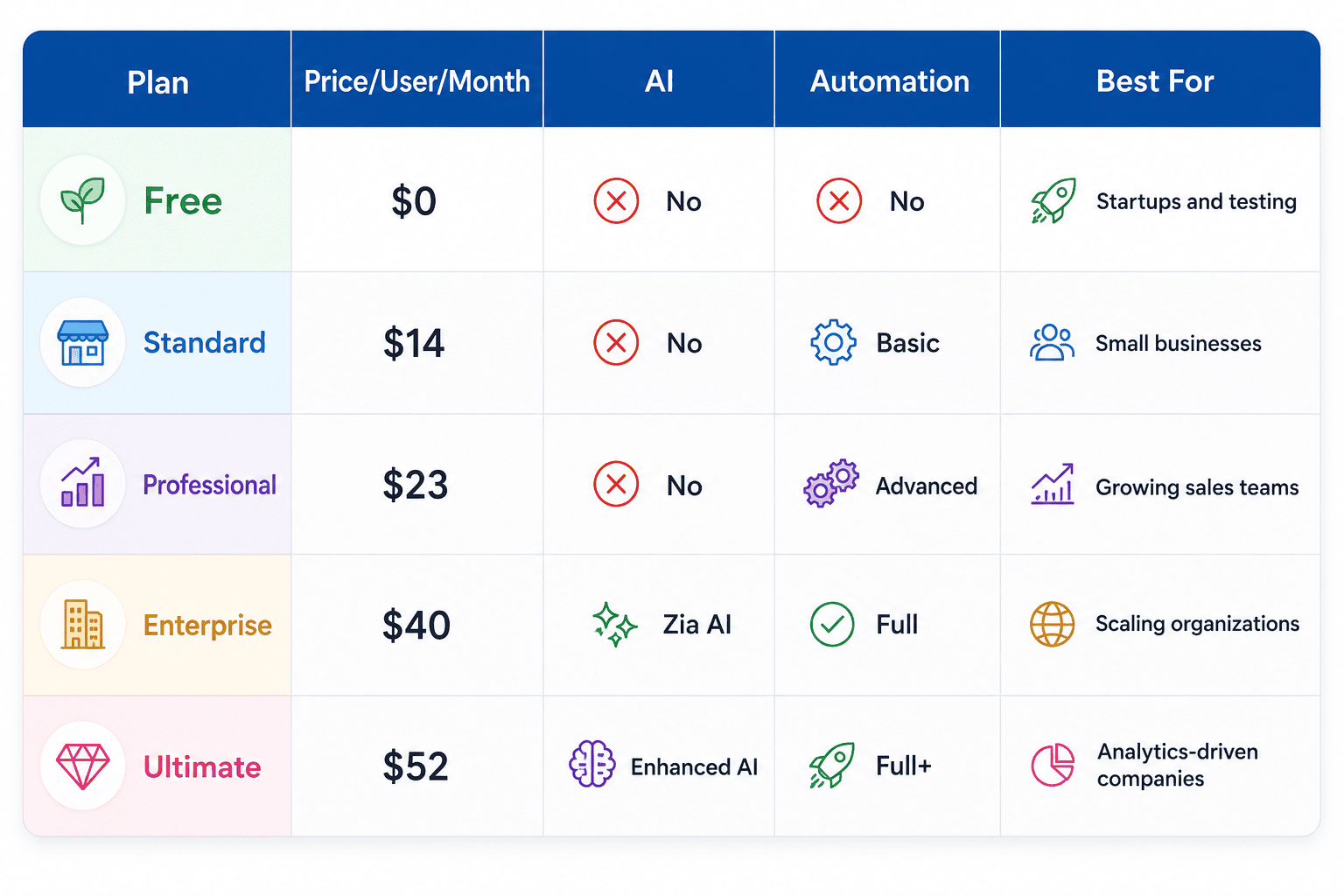
Zoho CRM Pricing Overview
Which Zoho CRM Plan Do We Recommend?
Based on our work implementing Zoho CRM for hundreds of US businesses, here are our straightforward recommendations by company stage.
Startups (1-3 Users, Early Stage)
Start with the Free plan to validate your sales process and CRM habits. Move to Standard the moment you hire a second salesperson or need email tracking and custom fields.
Small Businesses (5-15 Users, Established Process)
Professional is almost always the right starting point. Blueprint and workflow automation justify the price increase over Standard for any team with a repeatable sales process. If you are already doing product-based sales, Professional is non-negotiable.
Growing Companies (15-50 Users, Scaling Sales)
Enterprise. Full stop. Zia AI, custom modules, territory management, and the sandbox environment are not luxury features at this stage — they are operational necessities for a scaling sales organization. The ROI of Enterprise over Professional typically pays back within one to two quarters for teams of this size.
Mid-Market Organizations (50+ Users, Complex Operations)
Enterprise for most teams, Ultimate for organizations where executive analytics, BI reporting, or high-volume integrations are strategic requirements. We recommend engaging CRMOZ for a detailed needs assessment before committing to Ultimate, as Zoho One may offer better overall value depending on your broader software stack.
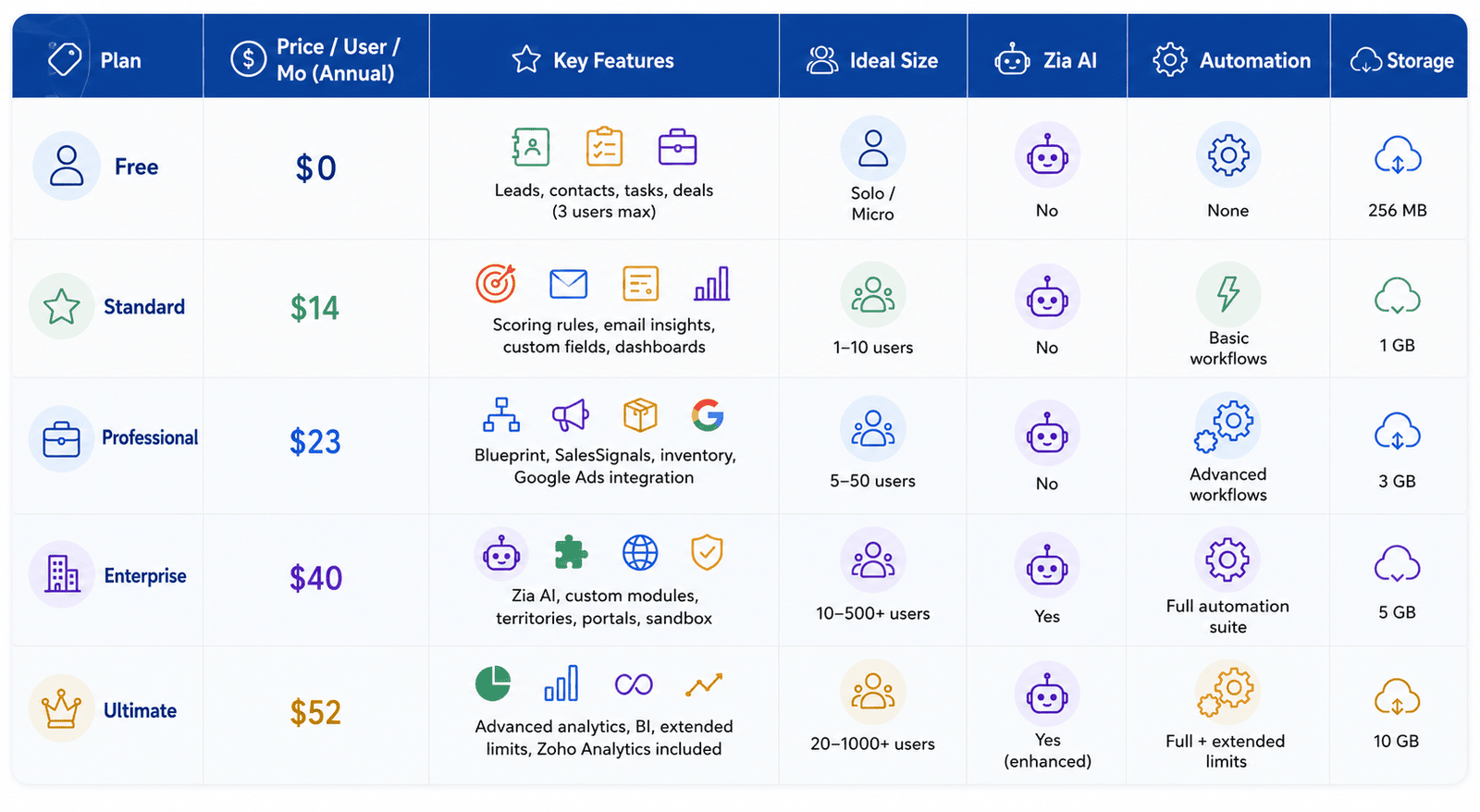
Zoho CRM Plans Compared
Need Help Choosing the Right Zoho CRM Plan?
Zoho CRM Free Plan: What You Get — and Where It Falls Short
What the Free Plan Includes
The Zoho CRM Free plan supports up to three users and provides the core building blocks of a CRM: leads, contacts, accounts, deals, tasks, and basic activity logging. You can log calls, send emails from within the platform, and track deals through a basic pipeline. It is a functional starting point for a solo founder or a very small operation that just needs somewhere to store contact data.
When to Upgrade
Upgrade the moment you hire your second salesperson, want to automate follow-ups, or need to report on pipeline performance to stakeholders. Staying on the Free plan past this point costs you more in lost productivity than the subscription fee would ever be.
Best Use Cases for Standard
Standard works well for teams of 1-10 people who have moved beyond spreadsheets and want a real CRM but do not yet have complex workflows or multiple sales channels. A small B2B services firm tracking 50-200 active prospects would be a good fit. If your team is growing or your sales process has more than three or four stages with specific rules at each step, you will want to look at Professional.
Zoho CRM Professional Plan: Where Real Automation Begins
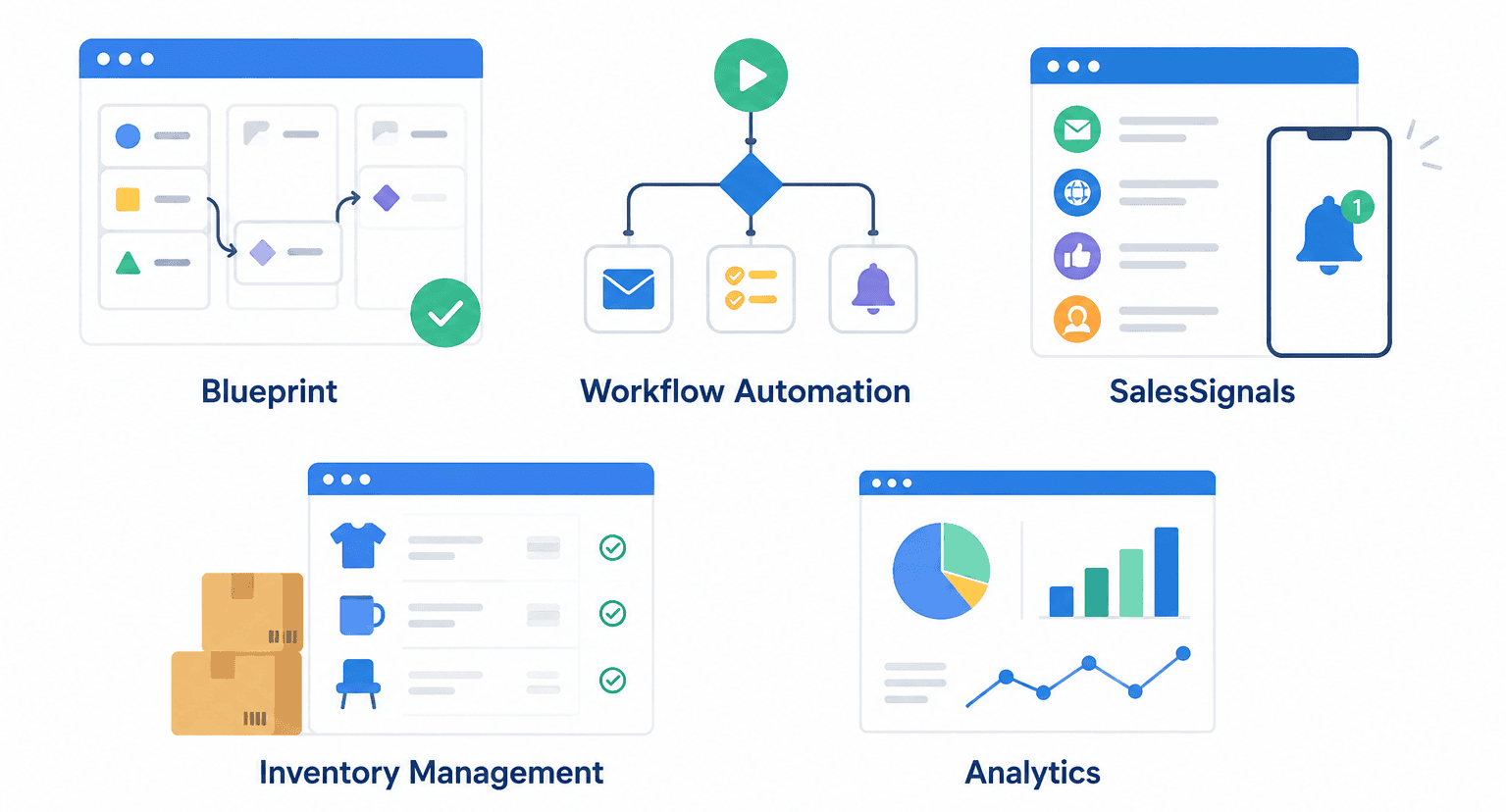
The Professional plan is where Zoho CRM starts to feel like a mature enterprise sales tool. For an additional $9 per user per month over Standard, you unlock a significantly more capable platform.
Blueprint: Enforcing Your Sales Process
Blueprint is one of the most underrated features in Zoho CRM Professional. It allows you to define the exact stages your deals must pass through, who can move a deal from one stage to another, what data must be captured before a stage change is allowed, and what actions automatically trigger when a transition occurs. Think of it as a flowchart for your sales process — built directly into your CRM.
Workflow Automation
Professional includes significantly more powerful workflow automation than Standard. You can build multi-condition workflows that trigger emails, update fields, create tasks, and notify team members based on deal activity, contact behavior, or time-based rules. This is where manual data entry starts to disappear from your day-to-day.
SalesSignals
SalesSignals delivers real-time notifications from every customer touchpoint — email opens, website visits, social media interactions, support tickets, and more — into a unified feed visible to your sales reps. This feature alone can meaningfully improve response times and conversation timing.
Inventory Management
Professional includes a basic product catalog, price books, quotes, sales orders, invoices, and purchase orders. For product-based businesses, this eliminates the need for a separate quoting tool and keeps your entire sales-to-invoice workflow inside Zoho CRM.
Zoho CRM Enterprise Plan: The Best Value for Growing Businesses
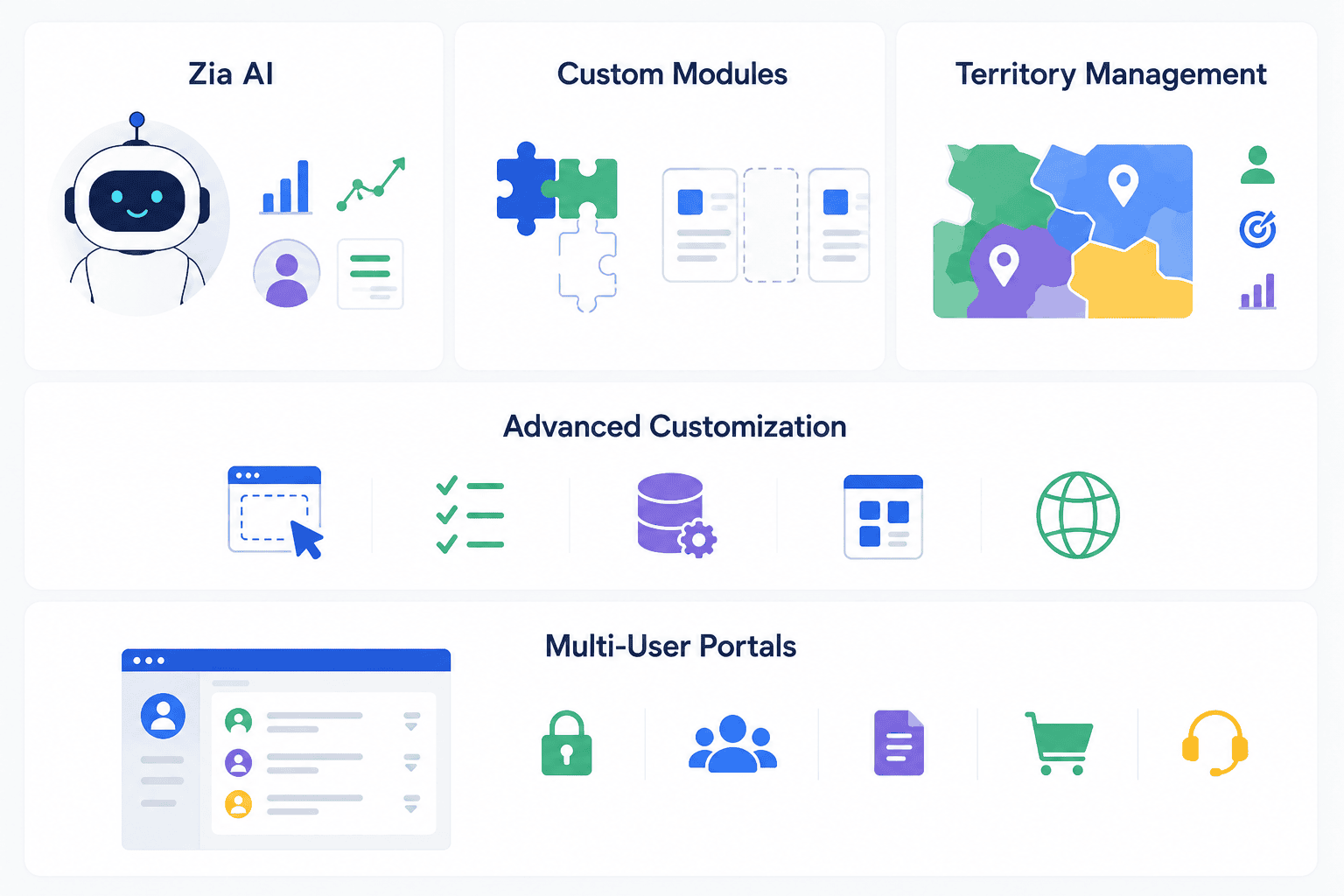
Zia AI: Your Intelligent Sales Assistant
Zia is Zoho's built-in AI engine, and it becomes available at the Enterprise tier. Zia analyzes your sales data to predict deal close probabilities, surfaces the best time to contact a lead, identifies anomalies in your pipeline, automates data enrichment, and provides next-best-action recommendations to your reps. For businesses generating sufficient volume of CRM activity, Zia becomes a genuine competitive advantage.
Custom Modules
Enterprise allows you to build entirely custom modules beyond the default Leads, Contacts, Accounts, and Deals. This is critical for businesses with unique data structures — think consulting firms tracking project deliverables, real estate agencies tracking property listings, or manufacturers tracking service contracts. Custom modules are what transform Zoho CRM from a generic sales tool into a purpose-built business platform.
Territory Management
For organizations with geographic or account-based sales territories, the Territory Management module in Enterprise allows you to assign accounts and opportunities to specific territories, set territory-level forecasts, and maintain clean rep accountability without complex manual assignments.
Advanced Customization
Canvas — drag-and-drop CRM record design for a completely custom user interface
Validation rules to enforce data quality at the point of entry
Sandbox environment for testing configurations before production deployment
Page layouts customized by profile, role, or record type
Multi-currency support for international sales teams
Multi-User Portals
Enterprise includes the ability to build customer and partner portals — giving external users limited, controlled access to their CRM records without a full paid license. This is highly valuable for B2B companies that want to give clients visibility into orders, project status, or support cases.
Zoho CRM Ultimate Plan: Maximum Power and Analytics
The Ultimate plan adds a layer of advanced analytics, intelligence, and extended platform limits on top of everything in Enterprise. It is designed for larger organizations where executive visibility, data-driven decision-making, and business intelligence reporting are strategic priorities.
Advanced Analytics and Business Intelligence
Ultimate includes Zoho Analytics as a bundled addition — a full business intelligence and reporting platform. This means your sales leadership can build executive dashboards, cross-functional reports, predictive forecasts, and board-level visualizations without exporting data to a separate tool. For companies running multiple departments through Zoho, this integration is particularly powerful.
Common Mistakes When Choosing a Zoho CRM Plan
Choosing Based Only on Price
The most expensive CRM mistake is buying the cheapest plan that technically works today. A sales team that grows from 5 to 20 users within 18 months and then discovers they need Blueprint, territory management, or Zia AI will face a disruptive mid-growth migration on top of their expansion hiring. Plan for where you will be in two years, not where you are today.
Ignoring Future Growth
Standard and Professional may look like the right choice for a 10-person team, but if you expect to double your headcount or move into new markets, Enterprise's territory management and custom modules will save you significant reconfiguration time later.
Underestimating Automation Needs
Many buyers underestimate how much time their team spends on manual CRM updates, follow-up scheduling, and lead routing. Even conservative automation — automatically assigning leads, sending follow-up sequences, and notifying managers of stalled deals — can save each salesperson 30-60 minutes per day. That time savings alone often justifies a higher-tier plan.
Overbuying Advanced Functionality
The opposite mistake also happens. A 5-person startup that signs up for Ultimate on the assumption that they will grow into it is paying for features and storage they will not use for years. Be honest about where your organization is today and pick a plan that fits your actual process maturity — then upgrade intentionally.
Ready to Get Started? Schedule a Free Zoho CRM Consultation
Not sure whether Standard, Professional, Enterprise, or Ultimate is right for your business?
CRMOZ can help evaluate your requirements, estimate total cost of ownership, and recommend the Zoho CRM edition that best fits your sales process, budget, and growth plans.