
5 Common Blueprint Failures (And How to Fix Them):
Why Your Business Strategy Isn't Working
You invested in a course, hired a mentor, or spent months designing the perfect growth strategy. You mapped out processes, drew funnels, outlined the customer journey. Everything looks right on paper — but nothing moves in real life.
This is the reality for most entrepreneurs who have a document but not a system.
A business blueprint isn't just a plan. It's the operational model of your company: how clients are acquired, how orders are processed, how teams scale, how results are measured and controlled. When a blueprint works, the business grows without your constant involvement in every detail. When it doesn't, you're trapped in a loop — putting out fires every single day.
The problem isn't the idea. The problem is execution.
Here are the 5 most common reasons business blueprints fail — and exactly what to do about each one.
Failure #1: Copying Someone Else's Model Without Adapting It
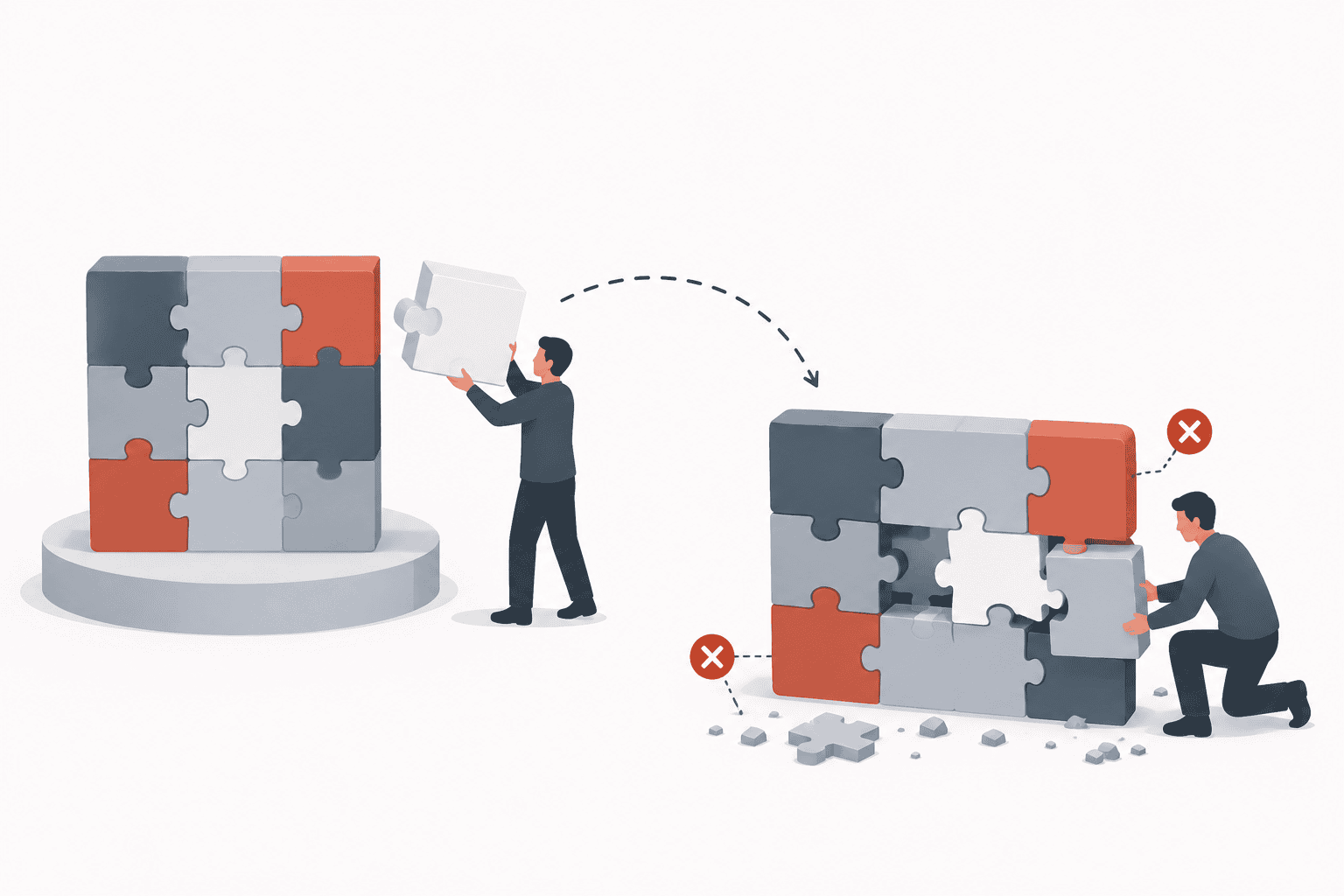
What's happening
Someone shows off a "proven business model" generating $1M per year. You buy the blueprint, implement it step by step — and nothing happens. Or worse: things break.
Copying other people's models is one of the most expensive traps entrepreneurs fall into.
Why it kills your blueprint
Every business model is tied to a specific market, audience, team, and resource base. What worked for a US-based SaaS startup with a 20-person team and a warm English-speaking audience won't work for a two-person consulting firm serving a local market with completely different buying behavior.
Real-world example
An online education founder copied a webinar funnel from an American info-marketer: free webinar → tripwire offer → core product. Conversion came in at 0.3% instead of the expected 5%. Why? The audience didn't trust a new brand, and the funnel was too long for cold traffic unfamiliar with the format.
How to fix it
Treat any external blueprint as a template, not a manual.
Audit your own audience: where they are, how they make decisions, what their average sales cycle looks like.
Adapt every stage to your reality: pricing, acquisition channels, decision-making triggers.
Test in small iterations before rolling out at scale.
Rule: Someone else's blueprint is a hypothesis. Your market is the only test of whether it's true.
Failure #2: No Operational System Behind the Strategy

What's happening
Entrepreneurs focus on strategy and sales, but ignore the operational layer — who does what, when, and how results get tracked. The outcome is chaos, total dependence on individuals, and clients falling through the cracks.
Why it kills your blueprint
A blueprint without an operational system is an architectural drawing without a foundation. You can design a beautiful building, but without clear processes, automation, and accountability — the project stalls at the paper stage.
Real-world example
A digital marketing agency had a detailed client acquisition strategy — well thought-out and ambitious. But they had no CRM and no lead-handling process. New inquiries landed in a Telegram group chat, managers responded randomly, and deals got lost in the noise. Out of 40 inbound leads per month, they closed 4–5.
How to fix it
Document your core business processes: from first client contact to deal close and repeat purchase.
Implement a CRM to track every lead and monitor deal stages in real time.
Automate routine actions: follow-up emails, reminders, status updates, task assignments.
This is exactly where platforms like CRMOZ become essential. It's not just a contact database — it's a full sales automation system that handles lead processing, pipeline management, and internal workflows. Instead of manually controlling every step, the system moves clients through the funnel, prompts managers to act, and records every outcome automatically.
Failure #3: Ignoring Data and Analytics

What's happening
Most entrepreneurs make decisions based on gut feeling rather than numbers. "Sales seem to have dropped." "I think this ad isn't working." "Customers are probably unhappy." Probably. Seem. Think. These are the words that cost businesses the most.
Why it kills your blueprint
A blueprint is supposed to deliver predictable results. Without data, you can't predict, optimize, or scale any process. You're navigating blind — and spending money on what feels right instead of what actually works.
Real-world example
An e-commerce owner invested $3,000 in paid ads based on "market intuition." After the campaign: 120 orders, near-zero profit. It turned out that 60% of sales came from low-margin products, and the ad budget hadn't been optimized toward profitable SKUs. Without analytics, there was no way to see this in time.
How to fix it
Define 5–7 core business metrics: CAC (customer acquisition cost), LTV (lifetime value), funnel conversion rate, average deal size, NPS.
Set up dashboards and weekly reporting — visible to the whole team, not just the founder.
Make strategic changes only after reviewing at least 2–4 weeks of data.
Modern CRM ecosystems, like Zoho, make this straightforward: every client, deal, and acquisition channel is tracked automatically, and analytics are available in real time — no manual spreadsheet consolidation required.
Failure #4: A Broken Customer Journey
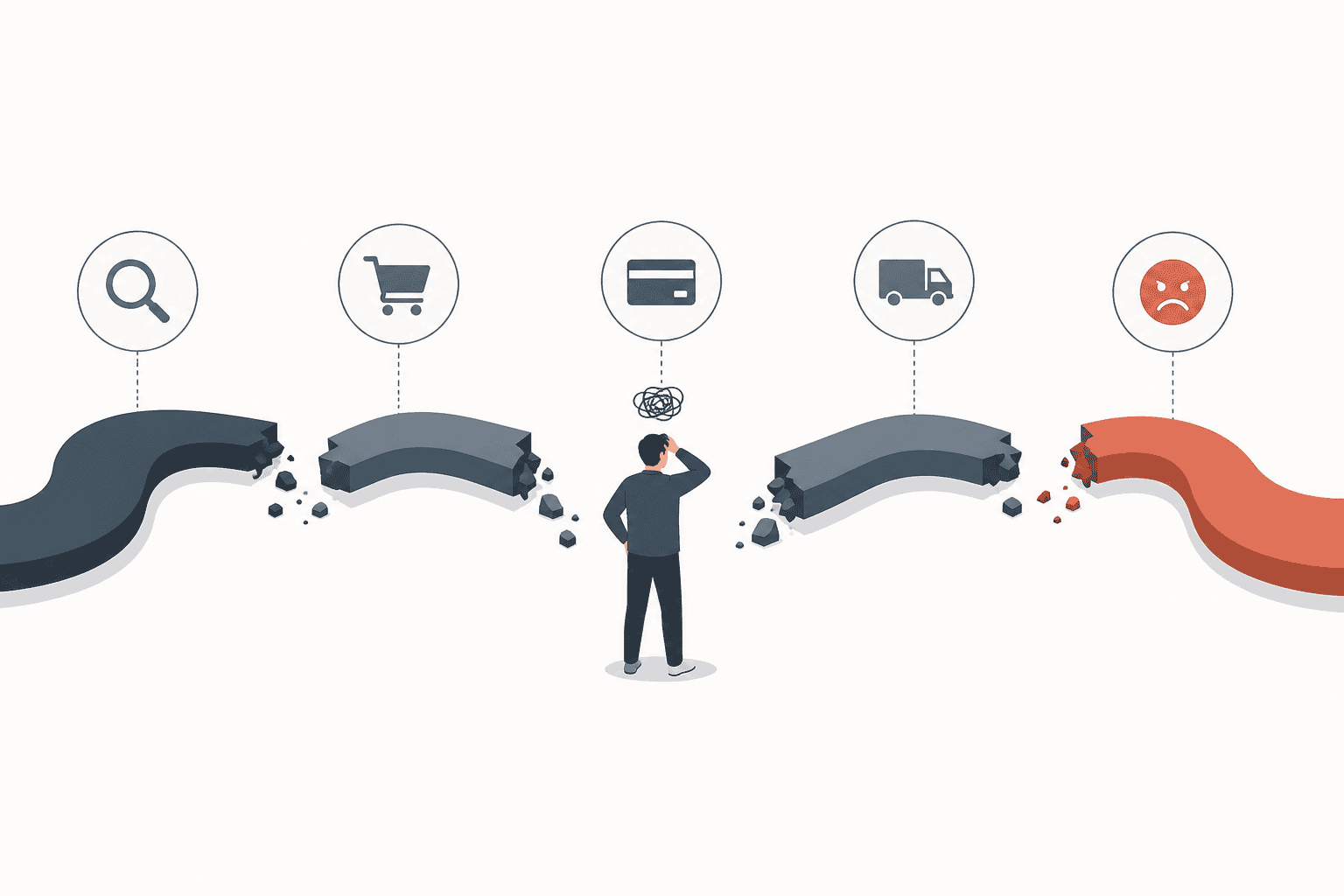
What's happening
Entrepreneurs think about their product, but not about the path their customer takes to get there — how they find out about the business, what they experience at each step, where they get stuck, and why they leave for a competitor.
Why it kills your blueprint
Even the best product won't sell if the path to it is confusing, inconvenient, or disappointing at any stage. A blueprint built without understanding the customer journey always has gaps — and money leaks through every one of them.
Real-world example
A consulting firm had a strong product and excellent content on social media. But between first contact and purchase, there was a week of silence. A prospect would leave an inquiry; a manager would call three days later, then send a proposal two days after that. By then, the client had already signed with a competitor.
How to fix it
Map the full customer journey: from first touchpoint (ads, referrals, SEO) to purchase and repeat engagement.
Identify "drop-off points" — stages where prospects most often disappear.
Automate communication: instant response to new inquiries, a follow-up sequence, manager task triggers.
A properly configured CRM closes this entirely. Every new lead gets an automatic response within minutes, and the manager sees the client's full interaction history in a single view — no digging through chats or emails.
Failure #5: No System for Scaling or Quality Control
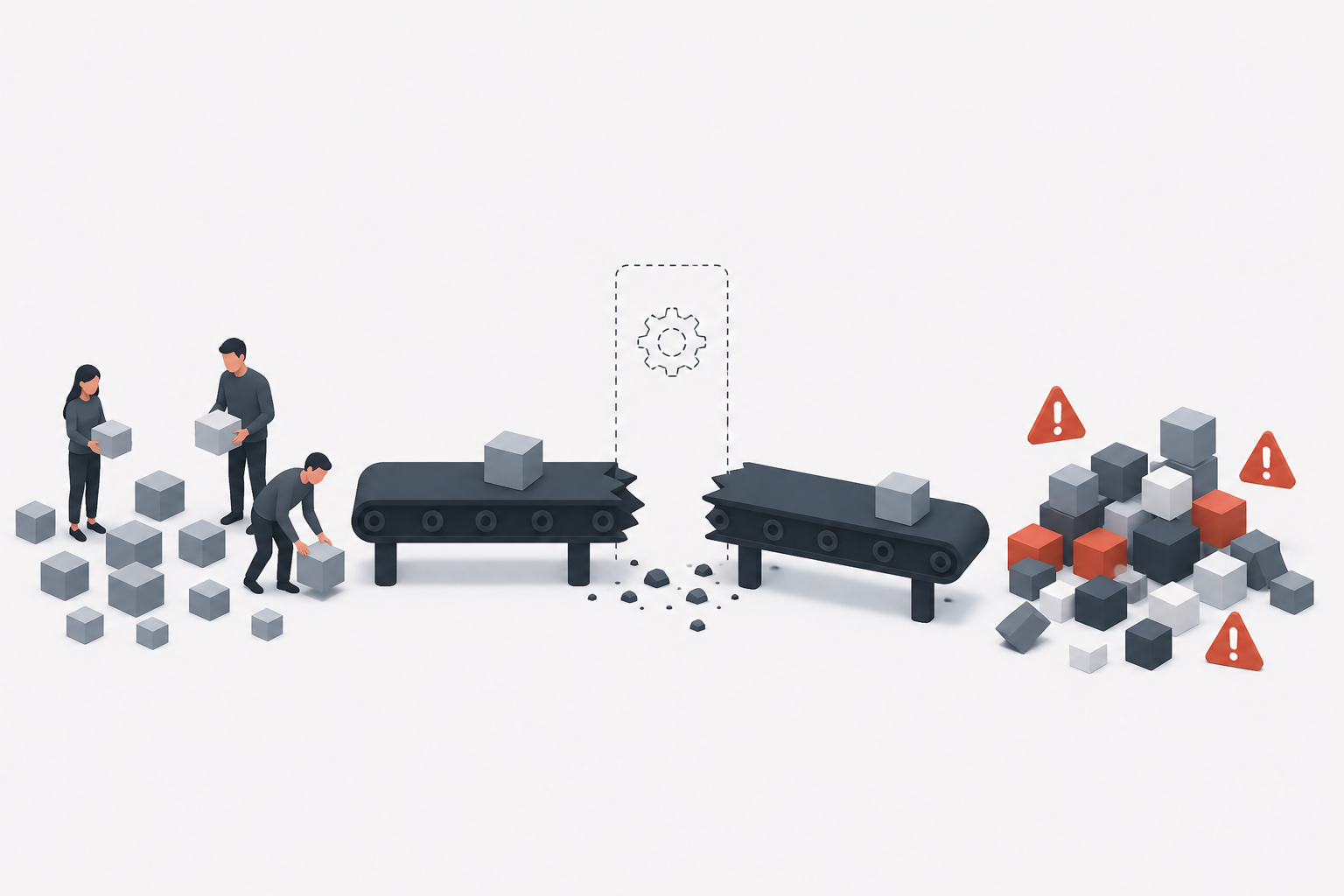
What's happening
Small businesses run on founder energy. But as the company grows, the founder becomes the bottleneck. Everything runs through them, every decision needs their approval — and growth stops dead.
Why it kills your blueprint
A blueprint that doesn't account for delegation, automation, and checkpoints is a blueprint built for one person. It doesn't scale. The business grows to a certain point — then stagnates, or the founder burns out.
Real-world example
A SaaS founder personally managed every client relationship, every invoice, every conflict. At 50 clients — manageable. At 200 — collapse. There were no SOPs, no quality control system, nothing that could be handed off. For eight months, the company couldn't break past the 200-client ceiling.
How to fix it
Document every key process so a new team member can execute it without your involvement.
Implement KPIs for the team and set up automated performance tracking.
Bring all client-facing and operational workflows into a single, unified system.
This is exactly the problem the Zoho ecosystem is built to solve — from CRM and marketing automation to project management, finance, and HR, all connected in one platform. And working with a certified Zoho Partner means you get it implemented correctly, fast, and tailored to your specific business — without months of trial and error or expensive configuration mistakes.
Fix Your Blueprint Right Now: A 5-Step Checklist
You don't need to overhaul everything at once. Start here:
✅ Step 1 — Audit your current state Write down which processes you already have and which are missing. Where is the most manual work? Where does chaos live?
✅ Step 2 — Define your key metrics Choose 5 numbers that most directly impact revenue. Track them every week, without exception.
✅ Step 3 — Map the customer journey Walk through your own sales process from the client's perspective — from first contact to purchase. Document every point of friction.
✅ Step 4 — Implement a CRM Even a basic CRM with lead automation will immediately improve conversion and eliminate sales chaos. Start simple and build from there.
✅ Step 5 — Delegate and automate Pick 3 processes you're still doing manually. Automate or delegate all three this month.
Want to audit your blueprint and find your real growth levers?
The CRMOZ team helps entrepreneurs implement CRM and operational systems on the Zoho platform — built to actually work, not just look good on paper.